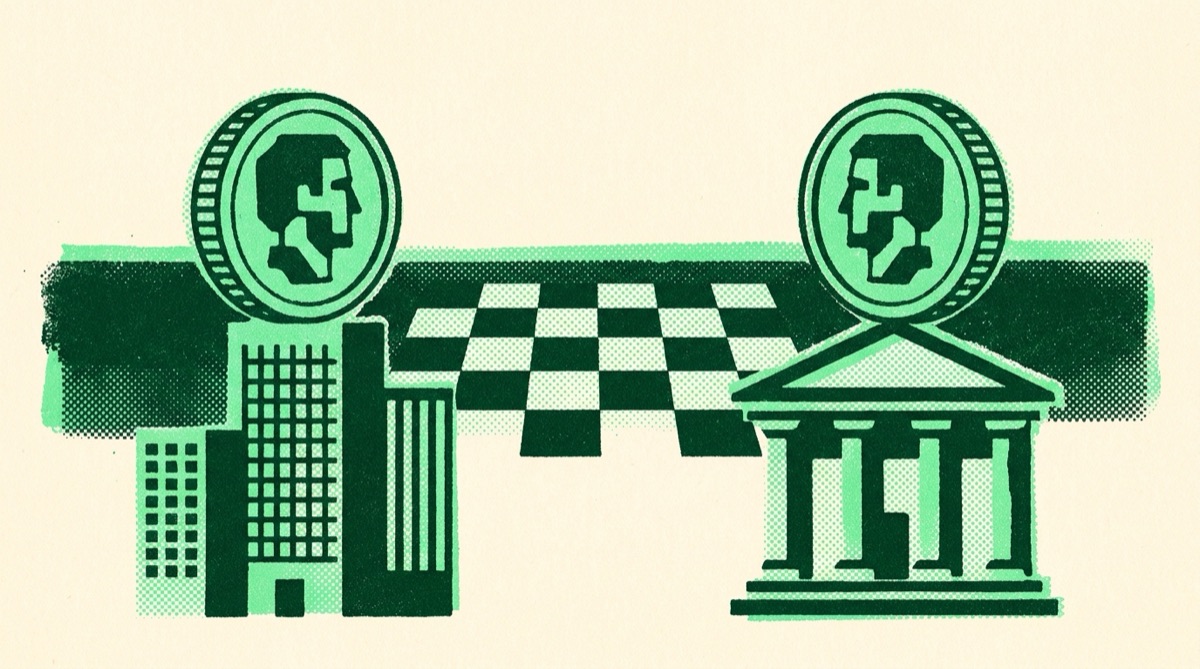
The difference between a stablecoin and a CBDC comes down to who issues it: a stablecoin is a digital dollar created by a private company and backed by reserves, while a CBDC (central bank digital currency) is digital cash issued directly by a country's central bank. Both aim to be worth exactly one unit of national currency; they just get there from opposite ends of the financial system.
Here's what makes the comparison fascinating in 2026: the world's biggest economies picked opposite sides. The United States embraced private stablecoins through the GENIUS Act and moved to ban a retail digital dollar outright. Meanwhile, China's e-CNY has processed billions of transactions, and the European Central Bank is marching toward a digital euro pilot. Same technology question, three completely different answers.
Does the label on your digital dollar actually matter to you? More than you'd think. It determines who can see your transactions, whether your money can earn interest, what happens if the issuer fails, and even what your government can program your money to do. In this guide, we'll compare stablecoin vs CBDC head to head, explain why the US went the way it did, and look at what's coming. New to the topic? Our pillar guide answering what is a stablecoin covers the private half of this story in depth.
Key takeaways
- Stablecoins are issued by private companies (Tether, Circle, PayPal) and backed by reserves; a CBDC would be issued by the central bank and backed by the government itself.
- The US chose stablecoins: the GENIUS Act became law in July 2025, and on June 22, 2026 the Senate voted 85-5 for a provision banning a Fed retail CBDC through 2030.
- Other powers went the other way: China's e-CNY had 230 million personal wallets and 16.7 trillion yuan in cumulative transactions by late 2025, and the ECB aims for a digital euro pilot in 2027.
- Privacy is the fault line: stablecoin ledgers are public but pseudonymous, while a CBDC could give a government direct visibility into retail payments.
- For US consumers, the practical answer through at least 2030 is stablecoins, dollars in apps, and no Fed coin.
Stablecoin vs CBDC: The Side-by-Side
Before the nuance, here's the whole comparison in one table.
| Feature | Stablecoin | CBDC |
|---|---|---|
| Issuer | Private company (Circle, Tether, PayPal) | Central bank (Fed, ECB, People's Bank of China) |
| What backs it | Issuer's reserves: cash and short-term Treasuries | The government itself; it is legal-tender money |
| Default risk | Issuer can fail; holders claim the reserves | None; a central bank can't run out of its own currency |
| Privacy | Public blockchain, pseudonymous; issuer can freeze funds | Design-dependent; state could see or limit transactions |
| Programmability | High; smart contracts, open networks | Possible, but controlled by the central bank |
| Interest to holders | Banned for US issuers under the GENIUS Act | Policy choice; could pay or charge rates |
| Status in the US (2026) | Legal and federally regulated | Blocked by executive order; statutory ban advancing |
Read down the columns and a pattern appears. The stablecoin column is about market dynamics: competition, innovation, and issuer risk. The CBDC column is about state power: perfect safety, but also potential visibility and control. Every country's choice between them is really a choice about which tradeoff it prefers.
One more distinction worth pinning down early: neither of these is Bitcoin. Both stablecoins and CBDCs are designed to hold a fixed value in national currency, so neither is an investment. They're competing designs for the same job, which is moving ordinary money digitally.
Who Issues Each One, and What Stands Behind It
A stablecoin is a liability of a company. When you hold USDC, Circle owes you a dollar, and your confidence rests on its reserves of cash and short-dated Treasuries, now mandated 1:1 and disclosed monthly under the GENIUS Act framework. The market is genuinely large: Tether's USDT stood near $184 billion and Circle's USDC around $75 billion in mid-2026.
A CBDC is a liability of the central bank, exactly like the paper bills in your wallet. There's nothing to redeem because it already is money; a central bank can't go bankrupt in its own currency. That's why economists call CBDC the "safest" form of digital money, with no depeg scenario and no reserve report to check.
The catch is what you give up for that safety. A retail CBDC would make the central bank a consumer-facing operator, competing with banks for deposits and with fintechs for payments. Critics across the political spectrum worried less about competition, though, and more about something else: visibility.
Privacy and Programmability: The Real Fault Line
Stablecoins run on public blockchains. Anyone can see the flow of funds between wallet addresses, but the addresses aren't names, and no single authority watches every purchase by default. Issuers can freeze specific addresses when courts or sanctions demand it. If you want to understand the plumbing beneath this, see our primer on the basics of blockchain technology.
A CBDC could be built with strong privacy, and the ECB promises cash-like anonymity for small offline payments. But the architecture makes surveillance possible in a way paper cash never was. A central authority could, in principle, observe retail transactions, impose spending rules, or switch funds off. US lawmakers named their bill accordingly: the Anti-CBDC Surveillance State Act.
Programmability cuts both ways too. Stablecoins plug into open smart-contract networks, which is why they power everything from remittances to automated commerce. A CBDC's programmability would belong to the state, useful for targeted stimulus, unsettling for anyone who dislikes money with conditions attached.
Why the US Said No to a Retail CBDC
America's position hardened in three steps. First, President Trump signed an executive order in January 2025 prohibiting agencies from establishing or promoting a CBDC, as recapped in Kiplinger's legislative roundup. Second, the House passed the Anti-CBDC Surveillance State Act on July 17, 2025, one day before the GENIUS Act was signed, pairing a green light for private digital dollars with a red light for a Fed-issued one.
Third, and most current: on June 22, 2026, the Senate voted 85 to 5 to approve a provision prohibiting the Federal Reserve from issuing a CBDC, attached to the Twenty-First Century Housing Act. As of July 2026 it still needs House passage, and notably, the ban sunsets at the end of 2030, after which Congress could explicitly authorize a project. So the US answer is "no for now," written in pencil, not stone.
The logic behind the choice: let regulated private issuers extend the dollar's reach digitally, keep the Fed out of retail accounts, and address surveillance concerns by never building the tool. Skeptics counter that dollar stablecoins already give the government subpoena-ready transaction records via issuers, so the privacy win is smaller than advertised. That debate, covered in our guide to the GENIUS Act stablecoin rules, is far from settled.
How the Rest of the World Is Choosing Differently
Step outside the US and the picture flips.
Europe: a digital euro on deck
The ECB finished its preparation phase in October 2025 and moved to the next stage of the digital euro project, selecting technology providers in early 2026 while EU lawmakers work to finalize the legal framework. Current planning points to a pilot around 2027 and possible issuance around 2029 if legislation lands on time, per the ECB's progress updates. Europe's motivation is strategic: reducing dependence on US card networks and, pointedly, on dollar stablecoins.
China: the e-CNY at scale
China is furthest along. By late November 2025, the digital yuan had processed 3.48 billion transactions worth 16.7 trillion yuan, with 230 million personal wallets opened. On January 1, 2026, a new framework took effect that treats e-CNY balances in bank wallets like interest-bearing deposits, moving it from "digital cash" toward everyday account money.
Consider Lena, an American product manager who spent three weeks in Shenzhen in 2026. She paid for trains and lunches from an e-CNY wallet her hotel helped her set up, and it worked flawlessly. What struck her was the asymmetry: back home in Chicago, her "digital dollars" were USDC in a fintech app, issued by a company she chose. Same tap-to-pay feeling, entirely different institution behind the money.
What It Means for You, and the Coexistence Future
For a US consumer in 2026, the practical takeaway is simple: your digital dollar will be private-sector issued for the foreseeable future. That means checking who issues a coin and how it's reserved actually matters, the way checking FDIC membership matters for a bank. It also means innovation moves at fintech speed; stablecoins already settle around the clock and plug into apps, wallets, and cross-border payment rails.
Consider Marcus, who runs a small e-commerce shop in Atlanta and pays a supplier in Portugal. Today he can settle an invoice in USDC in minutes on a Saturday. In 2029 his supplier might ask for digital euros instead, issued by the ECB. Marcus won't care about the ideology; his wallet app will convert one into the other. That's the likely endgame: coexistence, with stablecoins and CBDCs interoperating across borders the way cash and cards do today.
Globally, expect a patchwork through 2030. Dollar stablecoins dominating open networks, a digital euro arriving late this decade, the e-CNY deepening at home, and dozens of smaller pilots in between. The money in your pocket is quietly becoming a policy choice, and knowing the difference between the two models is how you read the map. For the everyday mechanics of holding any of these, our guide to how digital wallets work is the natural next read.
Frequently Asked Questions
Is a stablecoin the same as a CBDC?
No. A stablecoin is issued by a private company and backed by that company's reserves, while a CBDC is issued directly by a central bank and is government money itself. They can trade at the same $1 value, but the institution standing behind each one is completely different.
Why doesn't the US have a CBDC?
Policymakers chose regulated private stablecoins instead, citing surveillance concerns and banking disruption. A January 2025 executive order halted CBDC work, the House passed the Anti-CBDC Surveillance State Act in July 2025, and in June 2026 the Senate approved a ban on a Fed CBDC that runs through 2030, pending final House action.
Which countries actually have a CBDC?
Only a few have fully launched, including the Bahamas, Jamaica, and Nigeria. China's e-CNY is the largest large-scale rollout, with 230 million personal wallets by late 2025, and the EU is targeting a digital euro pilot around 2027 with possible issuance near 2029.
Are CBDCs safer than stablecoins?
In pure credit terms, yes: a central bank can't fail in its own currency, while a stablecoin issuer can. But US stablecoins now carry federal reserve and disclosure requirements, and holders get priority claims if an issuer fails. The bigger CBDC tradeoff isn't safety, it's privacy and government control.